


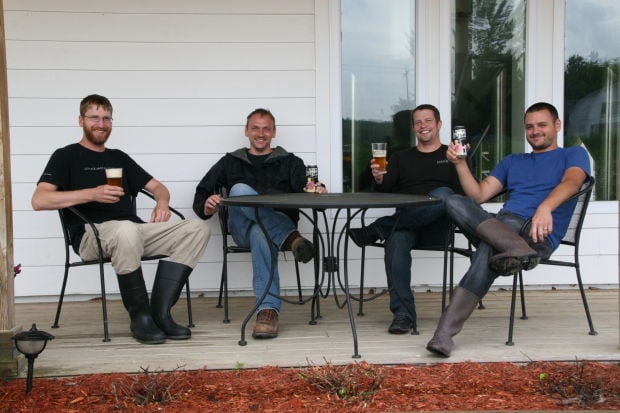


Seven years ago, Mike Wilson moved to Menomonie to take a job working with a beer distributor.
It was while living and working there his interest in craft beer really began to take hold, and a vision for a brewery began to form.
While he was learning the ins and outs of beer sales and distribution, he learned a bit about the city’s beer history. He was fascinated with the tale of the Burkhardt Brewery, which was a booming business in Menomonie in the 1890s.
“They put out about 60,000 barrels of beer a year,” Wilson said. “But during those times, because of transportation, it was difficult to ship the beer very far. So the local communities supported it and drank it happily.
“The beer was a source of great community pride. I was intrigued.”
That bit of intrigue stuck with Wilson during his time at the beer distributor. It also led him to meet Tim Schletty, who was, at the time, co-founding a successful bar-restaurant in town.
People are also reading…
After much talk, the pair decided to take things to the next level.
“We decided Menomonie was a great location for the brewery,” Wilson said. “It’s a progressive community. Its college even focuses on hospitality and tourism. It was a perfect fit.“
The site that ended up being available and was perfect for a brewing facility was, interestingly, along the same road the Burkhardt Brewery called home over a century ago — Hudson Road, across from where the Red Cedar Trail runs today.
Wilson, Schletty, and Tim’s father Fred Schletty worked on getting the inside of the brewery set up in 2009. In 2010, beer production began.
Today, the four-man operation is rounded out by two head brewers: Milwaukee-area native Jon Christiansen, who has 10 years of experience using a professional system, and Chippewa Falls native shift brewer Eric Rykal.
In its first year, Lucette produced around 400 barrels of beer. In 2012, it produced 1,500 barrels of beer.
“We’ve never gone through a full summer season offering canned beer yet, so I wouldn’t be surprised if we end up producing 2,500 barrels in 2013,” Wilson said. “We’re ready for it.“
Nothing about the brewery’s success has been a mere accident. Schletty and Wilson thought about everything — which included marketing a brand.
The ladies representing Lucette beer on tap handles and cans aren’t just pretty faces.
“We wanted to pay tribute to the lumber industry because it built Menomonie and surrounding communities,” Wilson said. “So we named the brewery Lucette based on Paul Bunyan’s sweetheart, who was Lucette.“
Differentiating from the market
Among the challenges facing small breweries is making themselves stand out in the sea of craft beers available today.
“We always think, ’What can we do to make our product different?’” Wilson said. “We want to provide value to the people we have relationships with — the wholesalers, consumers and retailers.”
So they started off with brewing just three varieties of beer, which were only initially available in kegs. They wanted to start small so they could closely monitor the beer quality and consistency.
“That was important to us,” Wilson said.
You also won’t find anything that tastes like typical mass-produced beers coming out of Lucette.
“What we’ve tried to do is to bring something else to market besides American ale,” Wilson said.
Their three flagship beers — Farmer’s Daughter (spiced blonde ale), Ride Again (American pale ale), Slow Hand (stout) — will soon be joined by a fourth, Hips Don’t Lie. The beer is a traditional German wheat beer made with honey and rose hips, and checks in at 6.2 % alcohol by volume (slightly higher than their other core beers).
The recipe for Hips Don’t Lie is something Rykal has been making for years at home.
“I’ve been perfecting the recipe for quite some time now,” he said. “It was a hit with the guys, so we’re adding it to the lineup.“
One of Lucette’s most popular beers has turned out to be Farmer’s Daughter; it’s often the one people who don’t consider themselves to be craft beer lovers end up trying and liking.
“I always tell people, judge us on our beer,” Wilson said. “We want people to buy it because it’s great. Don’t drink us just because we’re local.“
In 2012, Lucette decided to add a canning line and make its core beers available in cans in addition to kegs.
“Canned craft beer is becoming more prominent,” Wilson said. “The reason is because it extends the life of the beer.“
They also decided to distinguish themselves even further from other canned craft beers, and make it a value-added product for the consumer, by increasing the can size to 16 ounces and keeping the price the same.
“The shelf price is around $9.99, which is standard price for a six-pack of craft beer,” Wilson said. “But the consumer is getting more beer than they would in the standard size bottles.“
They have also produced two beers as part of a Belgian series, which uses more costly and sometimes challenging yeast strains. The Shining Dawn (a Belgian pale ale) and Double Dawn (a Belgian strong pale ale), are sold in kegs or champagne-style 750 ml bottles.
“Very few breweries produce Belgian beer because the increased expense with the yeast,” Wilson said. “We’ve chosen to do that, to bring a uniqueness and value to the consumer.”
The brewery also has other ideas in the works but plans to add new beer slowly.
“A lot of people have said, ‘I can’t get a local sour beer because no one’s making it around here,’” Wilson said. “I always say, ‘Give us time.’“
This year, they’ve started a 15-barrel batch series, the first of which is French Connection, a style known as Bière de Garde. For now that one is only available on draft.
Lucette is among a select few breweries in Minnesota and Wisconsin that just have a manufacturing facility.
“We don’t have a tap room for tasting and we don’t sell anything out of the brewery. You can’t take beer home or anything like that,” Wilson said, although they do run tours occasionally. “That could be seen as a disadvantage, but we prefer to send people down the road to one of the bars or restaurants where Lucette is available.“
Lucette is off to a running start and is poised to continue adapting to the craft beer market so long as the community continues to enjoy supporting it. Which is how the company likes it.


