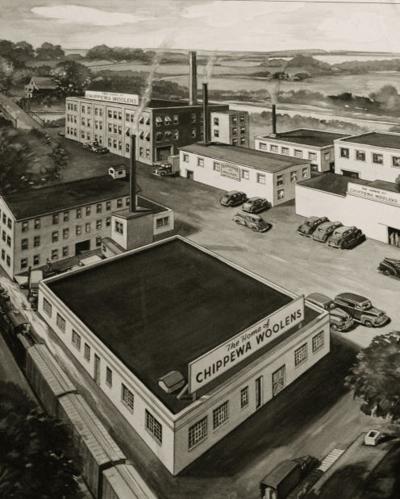


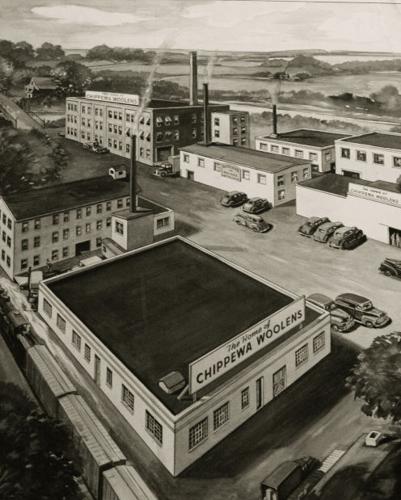
From 1882 to 1962, the Chippewa Woolen Mill played an important role in the economy of Chippewa Falls.
On Jan. 25, 2013, the Chippewa County Historical Society coordinated an interactive presentation on the history of the mill. To a standing-room-only crowd, Joe and Jim Mandelert and Greg Sleight shared their recollections and stories about the role the mill played in their lives.
About 80 photos of the mill and its employees, from the Joe Mandelert collection, were scanned by Jim Mandelert and included in a PowerPoint that was shown during the program. These photos have been added to our Chippewa County Historical Society collection.
Our guest speakers who worked at the mill reviewed the manufacturing process, procedures and history. Many other former employees also shared their memories.
Several attendees brought in Chippewa Woolen apparel and other memorabilia to display during the program. Some generously decided to donate the items they brought and these have been added to the society’s collection and will be on display for several months in the former convent dining room, now known as the Joe Joas Room.
People are also reading…
The mill was established for the purpose of supplying the men that worked in the lumber trade with warm and dependable clothing. During the 1920s, the mill employed about 100 people. For years it was the city’s largest employer.
The Chippewa Woolen Mill purchased wool from local sheep farmers and took it from the raw source all the way to the garment stage. It produced a variety of high-quality woolen products, including a complete line of men’s work clothing such as shirts, pants, breeches, jumpers, mackinaws and vests.
A large assortment of sportswear for men, women and children that included coats and smaller garments were also manufactured. A line of outerwear included men’s overcoats and topcoats and sport and dress coats for women.
Apparel was made for and sold with the Sears, Roebuck & Co. label. Auto robes, blankets and wool batting were also produced. U.S. Army blankets were also mass-produced.
The mill’s downfall came with the onset of synthetic fabrics. In 1962, the Chippewa Woolen Mill closed its doors and equipment was sold to cover company debts. During this time there were reportedly more than 300 other woolen mills that also closed down.
In the late 1980s, the City of Chippewa Falls acquired and razed the mill buildings. The mill was located on the property that now occupies the Leinie Lodge, as part of the Jacob Leinenkugel Brewing Company.
We are in the process of creating a Chippewa Woolen Mill historic marker recognizing the importance of this business. Because of the popularity and success of this program, it has been suggested that it be repeated when the historical marker is ready for installation. We anticipate that this will take place during the second half of 2014.
The following is feedback about the foregoing article that was published in our February 2014 newsletter, "The Eagle Speaks:"
“Dear Mr. Schuh; I enthusiastically read your article regarding the Chippewa Woolen Mill. My dad, Jacob Weiss, took the position of designer for the mill in early 1925… My dad had the idea for a reversible jacket with plaid wool on one side gabardine on the other, which he called the Bergen. However, he needed a reversible zipper to complete the garment, which was not available at the time.
"Falon Zipper Co. took on the task to invent one and they did and the Bergen became a huge success. He was first in putting zippers in children’s snowsuits, much to a mother’s delight. There were other such innovations…
"I am proud of my dad’s accomplishments and am proud of Chippewa Falls.” — Mr. & Mrs. Arthur R. Weiss, Scottsdale, Arizona.
(The Weiss family sponsored the cost of the soon-to-be created Woolen Mill historic marker.)
Jim Schuh is vice president of the Chippewa County Historical Society. For more information on the group, call 715-723-4399, or go to http://chippewacountywihistoricalsociety.org.