


Throwback photos: Postcards of the Past
These photos submitted by readers, the Cadott Historical Society and the Chippewa County Historical Society reflect some of the rich past of Chippewa County.
Postcard Cadott ONE rainwreck2 (2).jpg

Railroad services began in Cadott in 1880 with the arrival of the Wisconsin and Minnesota Railroad. With its arrival, Cadott’s development flourished because the railroad brought settlers and businesses, was the means of exporting timber, cattle, farm produce and the US mail. The railroad depot was a hub of activity with two waiting rooms, two ticket indows, an office, restrooms and a large freight room. A horse-drawn passenger shuttle took visitors and businessmen to and from town, a freight and the mail messenger service carried the US Mail to the post office. Pictured here is a picture of the Cadott Depot. You can see in the foreground the results of a train wreck which was, unfortunately, one of the several over the years.
Postcard Parks - Irvine P1990-23-49 CF ONE.jpg

For generations swans and ducks have been an attraction in the center of the park. The duckpond is located across Irvine Park Drive from the historic Picnic Pavilion that was built in 1908 by William Irvine.
Postcard Cadott SIX 1914 bettefire.jpg

On April 8, 1914, fire destroyed nine businesses on the west side of Main Street in Cadott.
Postcard Cadott THREE wanigan.jpg

The Yellow River was a “water highway” that played a major role in the settlement of the village of Cadott. when the era of fur trading diminished, the timber industry came into existence in this part of Wisconsin. For more than 30 years the Yellow River’s rushing waters were used by loggers to reach the Chippewa River from the great white pine forests. Early settler Robert Marriner platted the village in 1875 and built the first saw mill on his property along the Yellow River. By 1899 Wisconsin was producing three and a half billion board feet annually and led the world in lumber production. Logging continued to be a vital part of Cadott’s economy until the great forests declined. Pictured is the last wanigan to go down the Yellow River in 1908. A wanigan was a houseboat or float that accompanied the great logs down the river and served as an office and cook shanty for the crews.
Postcard Cadott TWO lawyer.jpg

A.J. Lockwood was an attorney practicing law in Cadott in 1883. In addition to being an attorney, he was justice of the peace and a notary public. He is pictured in his office during a meeting. In the photo, from left to right, are Hugh Wilson, Peter Emerson, Frank Zimmerman, Lockwood, John Downing and Steve Reynolds. Notice the hat on the table is the in the style of the time and the wooden table was used for a desk. A spitton sits under the table on what looks like a wooden plank floor.
Postcard Chippewa Falls and bridge.jpg

This is a photo of the Chippewa River.
Postcard Chippewa Woolens CF Four.jpg
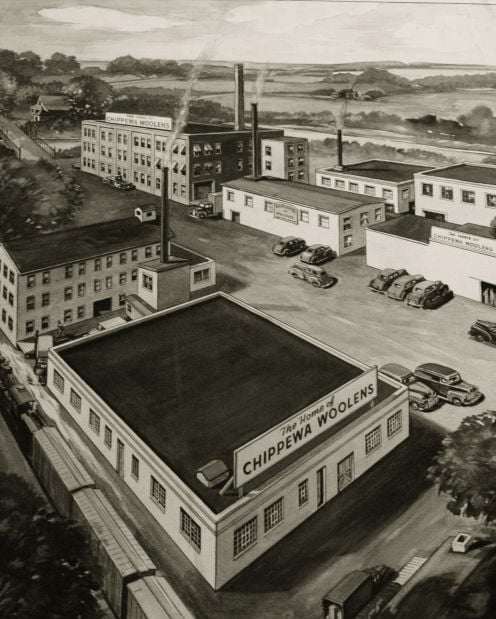
The old mill, erected in 1879 by Hector McRae, had the capacity to manufacture 100 barrels of flour every 24 hours.
Postcard Leinenkugel P1997-66-4 CF THREE.jpg

Tavern owners, posing behind their decorated automobiles, enjoy live music in the parking lot at the Jacob Leinenkugel Brewery. Prohibition was repealed in 1933. The newest autos in this line, the car second from the right and the third from left, are l933 Fords. That is why we believe that this could be a parade celebrating the end of prohibition. With repeal of Prohibition in 1933, the brewery converted back to the manufacture of beer. William Casper, vice president and secretary of the Leinenkugel Brewing Company, became associated with the brewery in 1933. He came to Chippewa Falls that year from a position with the First National Bank in Chicago, and had a great deal to do with the sound, steady growth of the local brewery. The flooring and cooperage had all dry-rotted and different-sized beer cases were in demand by the public. In spite of these and many other technical difficulties Leinenkugels started selling beer during June, 1933. 15,783 barrels of the delicious, full-bodied local beer were sold in that year. Increased demand for Leinenkugel product necessitated the brewing and distribution of 51,000 barrels in 1934.
Postcard Parks - Irvine P1995-109-13 CF TWO.jpg

One of the most photographed attractions in Chippewa Falls, the Glen Loch dam waterfall, was originally built to harness the waterpower of Duncan Creek. The mill, erected in 1879 by Hector McRae, had the capacity to manufacture 100 barrels of flour every 24 hours.
Postcard PAST THREE.jpg

Construction of the Elk Mound Tower at Mound Hill Park in the 1930s. Submitted by Travis Hakes.
Postcard Reader 5.jpg.jpg

This is the old Svelik Mill in Cadott around 1908. Submitted by Bart Chapek.
Postcard Reader 6.jpg

The Hans and Mary Lewandowski Jacobson family includes: William, Herbert, Waldemar, Irvin, Harold, Lillian, Marion, Mary, Marie and Hilda. Submitted by Travis Melville.
Postcard Reader GASS No. 17 Postcards-jpg.jpg

This is my mom & dad (Mel & Pat Gass) with my two brothers and myself. I'm the one in the middle with the devilish grin. I was about 7 years old at the time and our family lived in Birch Creek, just NW of Holcombe. When I was around 12, we moved to Cornell where dad owned and ran his own lumberyard for many years. When I graduated from Cornell High School in 1972 the lumberyard was in it's prime. In 1984, I graduated from Chippewa Valley Technical College (it was called District One) back then, the lumberyard was still in operation but the customer base had pretty much dried up due to competition from the large retail building centers like Menards. I'm the only one in the picture who lives out of state. Mom and dad are living in Bloomer, my brother Kim is in Portage and Robin in Chippewa Falls. The picture reflects some of the happiest days of my life and I will always remember how blessed our family was. Those were the days!...Kelly Gass
Postcard Reader No 7.jpg.jpg

The James Sargent Melville family including James, Clarence, Marshall, Ada, Devina (Webber) and Levi. Submitted by Travis Melville.
Postcard Reader No. 4.JPG.jpg

The Hartman House was built by George and Helen Hartman in November 1911. Submitted by Melanie McLaughlin.
Postcard Reader No. 14.jpg.jpg

Taken in 1907 by Bish Photographers. From left, Florence McLaren Nibbe, Mary (May) Cameron Emerson, Anna Bella (Belle) Cameron Emerson, Mabel C. King Macdonald, Bellette Evelyn Emerson Larrabee. These women, except for Florence, taught elementary school in Chippewa Falls. Florence worked in a shoe factory. Submitted by Marianne Emerson.
Postcard Reader No. 16.jpg.jpg

These are the three grown children of long-time Chippewa Falls resident Jenette Cameron, on the front porch of her home at 140 W. Cedar St. From left are: daughter Margaret Cameron Meyer, daughter Belle Cameron Chittenden, son-in-law Ernest H. Meyer and son Norman Cameron. Submitted by Marianne Emerson.
Postcard Reader Photo 13.jpeg.jpg

Mary (May) Cameron Emerson in 1887. Oldest daughter of Hugh and Jenette Cameron, who lived at 140 W. Cedar in Chippewa Falls. Photo taken in 1887 by Chippewa Falls Art. Co. Submitted by Marianne Emerson.
Postcard Reader Postcards PAST 10.jpg

George Hamm and his car in 1923. George owned Hillside Dairy and Hamm’s Cheese House, south of Chippewa Falls. Submitted by Gerry Byrnes.
Postcard ReaderNo. 11.jpg.jpg

Aerial photo of the Joan and Sylvester Kastel Dairy Farm in the late 1970s. The farm is in Stanley. Submitted by Greg Cesafsky.
Postcard Cadott 11 furtrader.jpg

Jean Baptiste Cadotte grew up in his fur trading father’s footsteps and organized the North West Company in partnership with a British man named Alexander Henry. Cadotte Falls was apparently named after him and he built the first crude outpost near the site of the present day village.
Postcard Cadott 12 Robert Marriner.jpg

Robert Marriner was the first white man to settle in Cadotte Falls. His wife, Eleanor, joined him in 1866, the same year her husband built his mill. Robert Marriner platted the village in 1875.
Postcard Cadott 10 icecutting.jpg

Men wearing hob nailed (spiked) shoes used a swa similar to a cross-cut saw but with a handle on one end so they could cut up and down into the ice making a two-foot by four-foot cake of ice. Gin poes were used to guide the ice cakes toward a flatbed on runners where tongs were anchored over the cakes and a horse with a rope attached to the tongs would pull the cakes onto the flatbed. The ice cakes were then taken to a ice house and packed in sawdust to be sold in warm weather to households having an icebox to keep perishable foods from spoiling. Several taverns, meat markets and grocery stores had their own ice houses because they used a larger amount of ice than an individual family. A 50 pound block of ice was selling for about one cent a pound in the early 1950s when the last local ice deliveryman, Bernard Falkenberg, discontinued this service.
Postcard Cadott EIGHT 1912 bette1.jpg

This view facing north on Main Street shows the business district before the fire of 1914. The Commercial Hotel on the corner of Ginty and Main Streets was the entertainment center of the village, hosting dances and parties and providing a balcony for viewing parades. Notice the unpaved street, board sidewalks and hitching posts.
Postcard CADOTT FIVE delformangrocery.jpg

Del Foreman serves a customer in his grocery store on Main Street. Notice the baskets of produce, the tin ceiling and the coal-burning stove and curved stovepipe.
Postcard Cadott FOUR drfoster.jpg

Cadott has been blessed with dedicated physicians since Dr. Clark Watson first practiced here in the early 1880s. In 1894 he was followed by Dr. R.B. Cunningham who was instrumental in the rebuilding of the west side of Main Street after the great fire of 1914. Today the same Cunningham building housed New Creations Hair Design, the Cadott Christian Community Center, the Cadott Sentinel and the U.S. Post Office. Other early Cadott doctors were Dr. Haag, Dr. Foster, Dr. Fletcher, Dr. Barnett, Dr. Baier, Dr. Robert Cunningham Jr. and Dr. Clarence Zenner who began practice in 1934. Pictured above is Dr. Foster, 1901-1913, accompanied by his dog in the carriage used to visit his patients.
Postcard Cadott NINE dray.jpg

With the coming of the railroad there came a means of receiving needed supplies quickly and safely to the Cadott community. Large amounts of merchandise, implements and food products were transported via the train to the Cadott Train Depot. This in turn created a real need for someone to transport that freight to and from the depot to the businesses and the individuals for whom it was intended. So the business of the dray came into existence. Actually, the dray means a heavy four-wheeled wagon pulled by one or two horses, mules or oxen and used to transport goods or people. And the dray in Cadott did both. There were eight to 10 passenger and freight trains through Cadott daily. The dray probably made several trips daily, delivering supplies to and from the depot, most likely later in the morning and later in the afternoon.
Postcard Cameron photo.jpg

This is a photo from November 1903 of Norman Cameron, age 14, on the left with two other men. Cameron, who was in Chi-Hi's first graduation class, worked as a clerk in Chippewa Falls and Detroit before enlisting in the Canadian Army to fight in World War I. While he did not return to live in Chippewa Falls, he visited often. Submitted by Marianne Emerson.
Postcard Cadott SEVEN 1914e afterfireeastside.jpg


